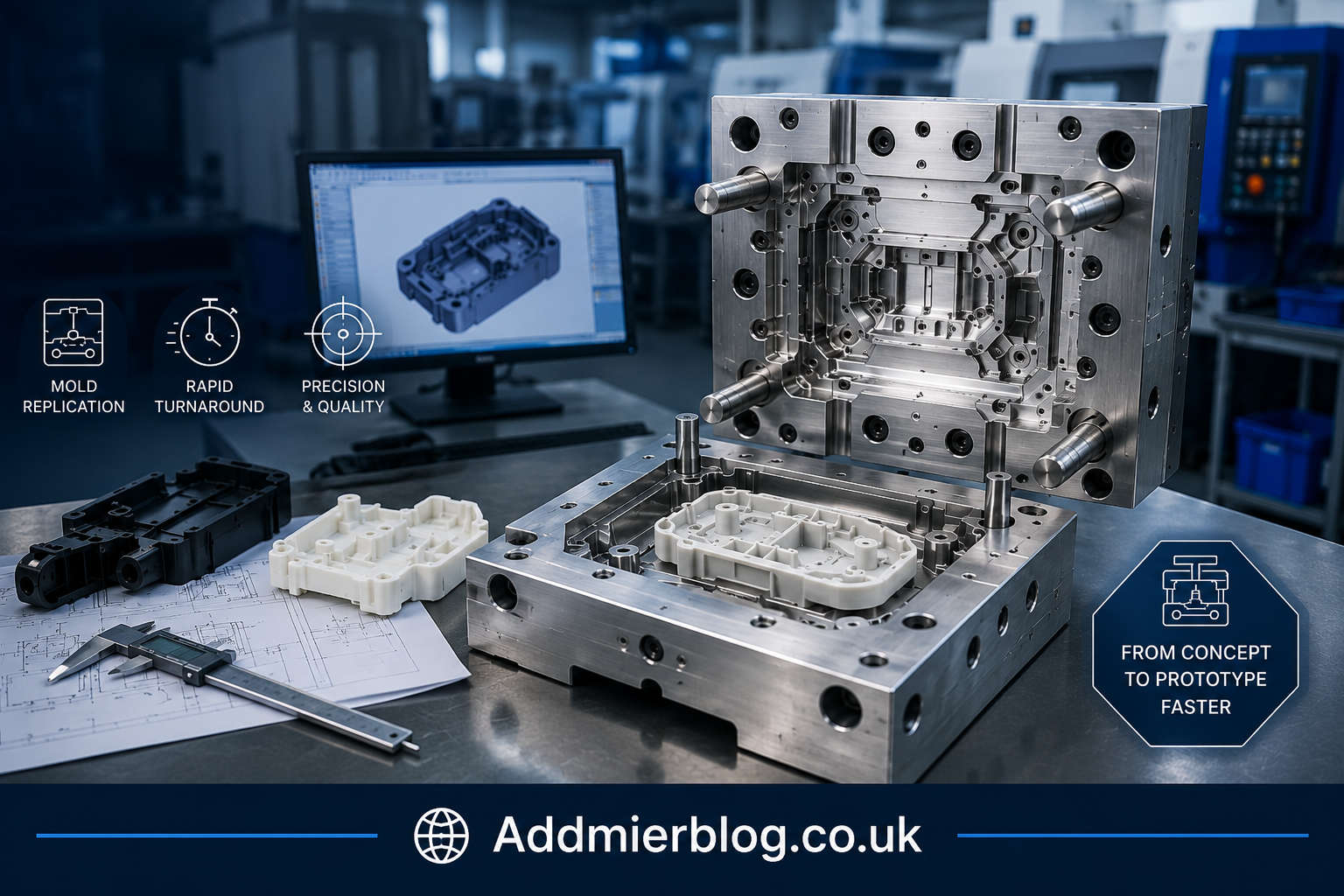
Repmold is best understood as a practical approach to mold replication, rapid tooling, and repeatable part production. In simple terms, it connects the idea of “replication” with “molding.” That makes it relevant for industries where a product shape must be repeated accurately, whether for prototypes, small production runs, testing, replacement parts, or early-stage manufacturing.
The value of repmold lies in its focus on speed, consistency, and controlled reproduction. Traditional mold production can take time because it often requires detailed design, machining, polishing, testing, and correction. Repmold methods aim to reduce some of those delays by using digital design, master patterns, flexible molds, 3D-printed inserts, silicone tools, or other replication-based processes.
This does not mean repmold replaces every traditional mold-making method. In high-volume production, hardened steel molds and fully engineered tooling still have a strong place. But for prototypes, limited batches, design validation, and quick testing, repmold can provide a more flexible route.
What Repmold Means
Repmold is not always used as a single fixed industrial standard. Different writers and companies may use the word in slightly different ways.
The idea is simple. A master shape is created first. That master may be made through CNC machining, 3D printing, hand finishing, or another fabrication method. A mold is then made from that master. Once the mold is ready, it can be used to produce repeated copies of the same shape.
This approach is close to long-established techniques such as replica molding, silicone molding, rapid tooling, soft tooling, and low-volume casting. In soft lithography, for example, replica molding uses a patterned mold to transfer surface features into another material. A common example is PDMS molding, where a liquid polymer is poured over a master pattern, cured, and removed to form a replica.
The word repmold is useful because it gives a short name to a wider production idea: making molds and replicas in a controlled, repeatable, and faster way.
Why Mold Replication Matters
Molds are central to manufacturing because they define the final shape of a product. A mold can be used for plastic parts, rubber items, silicone products, cast components, resin pieces, medical models, packaging parts, and many other objects.
In conventional injection molding, molten material is injected into a mold cavity and allowed to cool or cure into the required shape. This process is widely used for producing plastic parts at scale. However, the mold itself can be expensive and time-consuming to make, especially when the design is complex or when tight tolerances are required.
This is where repmold becomes useful. Instead of committing immediately to expensive final tooling, a manufacturer can create a replicated mold or soft tool for testing. This helps teams check whether the shape works, whether the part fits with other parts, and whether the material behaves as expected.
For product developers, this can prevent costly mistakes. A design may look correct on a screen but fail during assembly, handling, sealing, or repeated use. A replicated mold allows the team to produce real parts and identify problems earlier.
How Repmold Works
The basic repmold process usually starts with a digital or physical model. The model represents the part or surface that needs to be copied. If the design begins digitally, it is often prepared in CAD software. The file is checked for wall thickness, draft angles, undercuts, shrinkage, and parting lines.
After that, a master pattern is produced. This master must be accurate because any error in it can be transferred into the mold and then into every copied part. The master can be 3D printed for speed, CNC machined for accuracy, or created through another suitable method.
The next stage is mold creation. Depending on the material and purpose, the mold may be made from silicone, resin, metal, composite, or a 3D-printed tooling material. For short runs, silicone and polymer molds are common because they are faster and cheaper than hardened metal molds. For more demanding runs, aluminum or steel may be used.
Once the mold is prepared, the chosen production material is poured, injected, compressed, cast, or formed into the mold cavity. The part is then cured, cooled, or hardened before removal. The final pieces are checked for surface finish, dimensions, defects, and functional performance.
A good repmold process does not end with making one copy. It includes inspection and adjustment. If parts show warping, bubbles, flashing, poor filling, or surface defects, the mold or process settings must be corrected.
Materials Used in Repmold
The materials used in repmold depend on the final part and the purpose of production. For prototype molds, silicone is widely used because it can capture fine details and release parts easily. Silicone molds are often used for resin casting, art pieces, product samples, medical models, and low-volume production.
For plastic prototypes, 3D-printed molds or inserts may be used. Additive manufacturing is increasingly used to make molds, inserts, and patterns for processes such as injection molding and casting. NIST notes that 3D printing can reduce process steps and material waste when used for molds, mold inserts, and patterns.
For stronger tooling, aluminum is common because it is easier to machine than steel and can support moderate production volumes. Steel remains the choice for high-volume manufacturing because it can withstand repeated pressure, heat, and wear over long production cycles.
The part material may include polyurethane resin, epoxy resin, silicone rubber, thermoplastics, wax, plaster, or low-melting casting materials. Each material has its own curing behavior, shrinkage rate, hardness, flexibility, and surface finish.
Choosing the right material is not only a cost decision. It affects the accuracy, durability, and usefulness of the final part.
Main Uses of Repmold
Repmold is useful in several areas of manufacturing and product development.
The first use is prototyping. Designers can produce real parts before investing in final tooling. This helps them test size, grip, fit, assembly, weight, and appearance.
The second use is low-volume production. Some products do not need thousands of units. A company may need 20, 100, or 500 parts for testing, field trials, or early sales. Repmold can support this kind of production without the full cost of permanent tooling.
The third use is replacement parts. When an original mold is lost, damaged, or unavailable, a replication process can sometimes help recreate the required shape from an existing part or master.
The fourth use is medical and educational modeling. Patient-specific models, training parts, and anatomical replicas often require flexible production rather than mass production. Research has shown that 3D-printable molds can be used to produce detailed silicone medical models for training and planning.
The fifth use is surface replication. Some industries need to copy fine textures, patterns, channels, or microstructures. Replica molding has long been used in microfabrication and soft lithography because it can transfer small surface features into polymers.
Benefits of Repmold
The first major benefit is shorter development time. A team can move from design to sample parts faster than with traditional tooling. This is useful when several design versions must be tested.
The second benefit is lower upfront cost. A replicated or soft mold usually costs less than a hardened production mold. This makes it easier for small businesses, inventors, researchers, and early-stage product teams to test ideas.
The third benefit is design flexibility. If a part needs changes, the mold can often be adjusted or remade without the same financial loss linked to permanent tooling.
The fourth benefit is material testing. A physical part gives better information than a digital model alone. Teams can test flexibility, strength, surface quality, sealing, heat resistance, and user handling.
The fifth benefit is reduced risk. Before a company commits to high-volume tooling, it can use repmold methods to confirm whether the design is ready.
Limits and Challenges
Repmold is useful, but it has limits. A soft mold may not last long under repeated use. Silicone molds can tear, stretch, or lose accuracy after multiple cycles. 3D-printed molds may have heat limits, surface texture issues, or lower durability than machined metal molds.
Accuracy is another challenge. Every replication step can introduce small changes. If a master pattern is slightly wrong, the mold will copy that error. If the mold shrinks or deforms, the final part may not meet the required dimensions.
Surface finish also matters. A 3D-printed master may show layer lines unless it is polished or coated. Those lines can transfer into the mold and appear on the final part.
Material compatibility must also be checked. Some casting materials may stick to the mold, react with it, or generate heat during curing. Release agents, proper curing times, and controlled temperatures are often necessary.
Repmold is also not always the right choice for mass production. If a company needs hundreds of thousands of identical plastic parts, traditional injection molding with hardened steel tooling may still be more reliable and cost-effective over time.
Quality Control in Repmold
Quality control is important because the purpose of repmold is repeatability. A mold that creates inconsistent parts is not useful.
Basic quality checks include measuring dimensions, checking weight, inspecting surface finish, testing part fit, and looking for defects such as bubbles, cracks, sink marks, warping, or incomplete filling.
The process should also track mold life. A mold may produce good parts for the first few cycles but lose detail later. Keeping a record of cycle count helps identify when a mold should be repaired or replaced.
For technical parts, quality control may include hardness testing, tensile testing, pressure testing, thermal testing, or chemical resistance testing. The level of testing depends on the product’s use. A decorative resin item does not need the same inspection as a medical, automotive, or industrial component.
Repmold and Digital Manufacturing
Digital tools have made repmold more practical. CAD software allows designs to be prepared and corrected before physical work begins. 3D scanning can capture the shape of an existing object. 3D printing can create master patterns and short-run mold inserts. Simulation tools can help predict filling, shrinkage, and possible defects.
This connection between digital design and mold replication is one reason the term repmold appears in discussions about modern production. It describes a workflow where the physical mold is not treated as a slow, isolated step. Instead, it becomes part of a faster design-test-correct cycle.
Additive manufacturing is especially important here. Research on rapid tooling shows that molds or inserts for injection molding can be produced by additive manufacturing, although material choice, heat resistance, accuracy, and tool life remain important concerns.
When Repmold Makes Sense
Repmold makes sense when speed, testing, and flexibility matter more than long-term tool life. It is suitable for prototypes, pilot batches, product samples, research models, custom parts, small production runs, and design validation.
It is also useful when a company needs to show investors, buyers, or clients a working physical product. A real part can communicate function better than a drawing or render.
However, repmold should be chosen carefully. If the product has tight tolerances, strict safety requirements, or high production volume, the team should compare it with CNC machining, traditional injection molding, die casting, or other manufacturing methods.
A good decision starts with simple questions: How many parts are needed? What material will be used? How accurate must the part be? How long must the mold last? What surface finish is required? How much change is expected after testing?
Conclusion
Repmold is a practical concept built around mold replication, rapid tooling, and controlled part reproduction. It helps manufacturers and product developers create physical parts without immediately committing to expensive full-scale tooling.
Its main strength is flexibility. It allows teams to test, adjust, and produce small batches with less delay. It can support product development, medical modeling, replacement parts, surface replication, and low-volume manufacturing.
At the same time, it is not a universal replacement for traditional mold making. Mold life, accuracy, surface finish, material behavior, and production volume must be considered before choosing the process.
For businesses that need fast samples, limited production, or a practical way to move from design to real parts, repmold offers a useful path. It sits between digital design and finished manufacturing, giving teams a way to copy shapes, test ideas, and produce usable parts with more control.