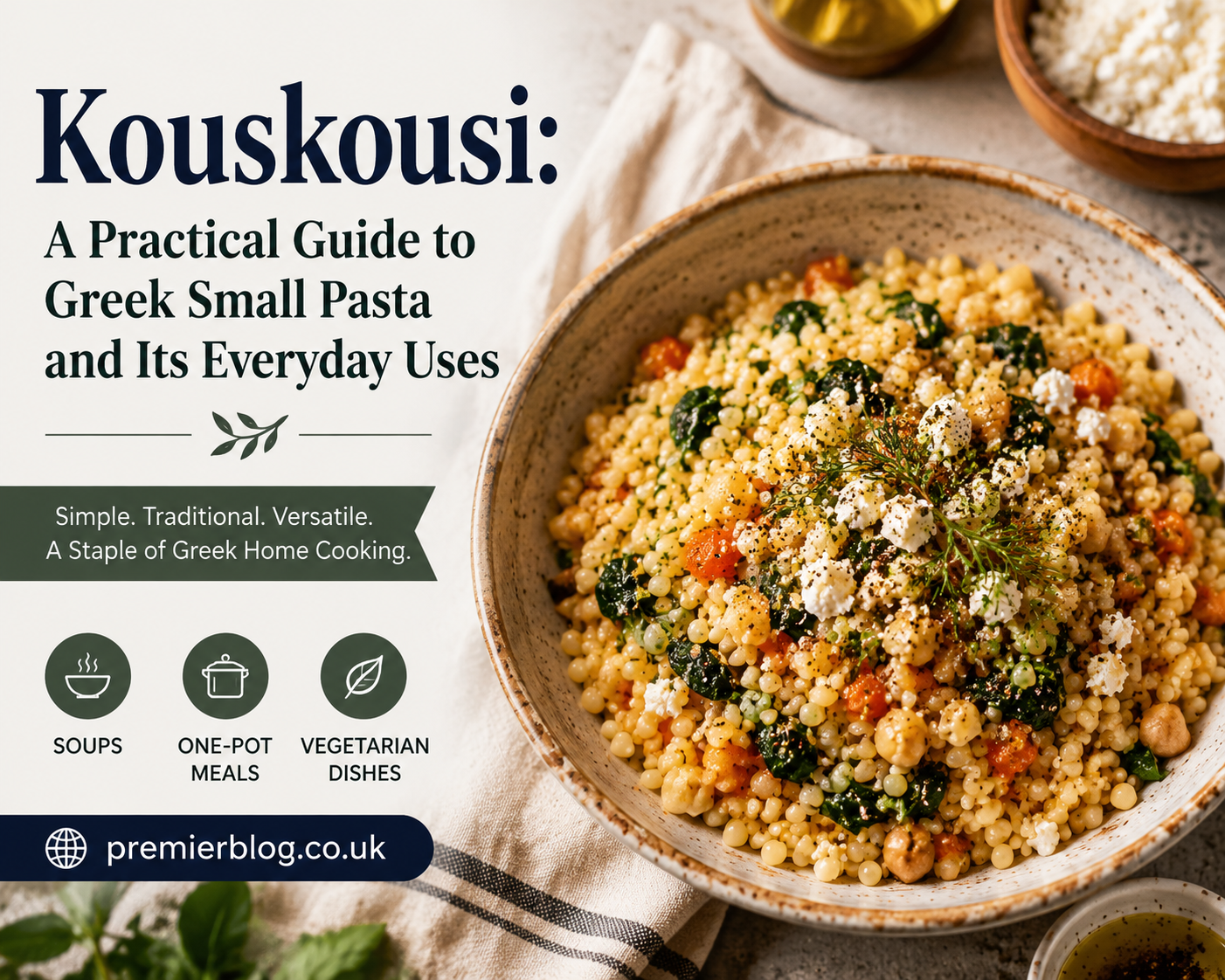
Kouskousi is a small wheat-based food commonly associated with Greek and wider Mediterranean cooking. At first glance, it looks like a grain because it consists of small, round pieces. However, the Greek version is generally treated as a type of pasta made from durum wheat semolina.
The name can create confusion because it closely resembles “couscous,” the North African food prepared from rolled and steamed semolina. In some regions, the words may be used interchangeably, while in others they describe products with different preparation methods, sizes, and textures.
In Greece, particularly in northern regions, kouskousi or kouskousaki may refer to small pasta balls that are boiled in water or cooked directly in soup. The pasta is used in home meals, meat dishes, salads, vegetable recipes, and simple side dishes.
Understanding the difference between Greek kouskousi and North African couscous helps cooks choose the correct preparation method and avoid poor results.
What Is Kouskousi?
Kouskousi is a form of fine pasta made mainly from durum wheat semolina and water. The pieces are small and round, giving the product an appearance similar to coarse grains, tiny beads, or large couscous.
A Greek pasta manufacturer describes kouskousaki as small, round balls made from durum wheat. It categorises the product as pasta for soups and recommends boiling it for approximately 12 to 14 minutes. The same product is made with durum wheat semolina and water.
The exact form may vary between producers. Some versions are very small, while others are closer in size to pearl couscous. Traditional or locally produced varieties may also contain milk or egg in addition to semolina. For this reason, buyers should read the ingredient list instead of assuming that every package contains the same recipe.
Although the pieces resemble grains, the Greek commercial version is normally boiled like pasta rather than simply soaked in hot water.
Why the Name Can Be Confusing
The word kouskousi is closely related to couscous, but its meaning is not completely standardised across countries and regions.
Traditional North African couscous is made by moistening semolina, rolling it into small granules, sieving it, and then steaming it. It is widely associated with the cuisines of Morocco, Algeria, Tunisia, Libya, and other parts of North Africa. A scientific review describes couscous as a durum wheat semolina product formed through the addition of water, followed by physical and thermal processing.
Greek kouskousi, by comparison, is often manufactured as pasta. It is boiled until tender in the same general way as orzo, small noodles, or other soup pasta.
Regional language adds another layer of confusion. In the Greek region of Thrace, the term kouskousi may be used for couscous, while the same or similar word can describe a local pasta product elsewhere.
Therefore, the name alone may not tell a cook exactly what is inside the package. The most reliable approach is to check the ingredients and cooking instructions.
If the label tells the cook to cover the product with hot water for a few minutes, it is probably precooked couscous. If the instructions call for 10 to 15 minutes of boiling, it is more likely to be Greek-style pasta.
Regional Background
Kouskousi is connected mainly with northern Greek food traditions, including cooking in and around Thrace and Macedonia. Commercial Greek versions are often presented as a regional pasta from northern Greece.
Northern Greek cooking has been shaped by agriculture, livestock farming, trade, migration, and contact with neighbouring food cultures. Wheat products, handmade noodles, dairy ingredients, legumes, soups, and slow-cooked meat dishes are common parts of the regional kitchen.
Small pasta was practical in household cooking because it could be dried, stored, and used in several types of meals. It could add substance to broth, extend a meat dish, or provide a simple base for vegetables and cheese.
Traditional preparation was not always identical to modern factory production. Homemade versions could include semolina, flour, milk, egg, or a combination of ingredients. Families and local producers developed their own proportions and drying methods.
Today, most consumers are likely to encounter packaged versions made under controlled production conditions. These products offer more consistent size, cooking time, and texture than handmade pasta, although locally produced varieties remain available.
How Kouskousi Is Made
Commercial kouskousi begins with durum wheat semolina. Durum wheat is commonly used for pasta because it creates dough that holds its shape during cooking.
The semolina is mixed with water to form a firm dough. The dough is then shaped into small pieces, dried, packaged, and sold as shelf-stable pasta. The final product may look like small pellets rather than a conventional noodle.
The production method is important because it affects how the food behaves in the kitchen. A manufactured pasta ball usually requires boiling. It absorbs water gradually and becomes tender while maintaining some firmness.
Traditional couscous follows a different process. Semolina is moistened and rolled into granules rather than being formed from standard pasta dough. Traditional couscous is normally steamed, while many supermarket varieties are precooked and only require rehydration.
This production difference explains why the two foods cannot always be substituted using the same timing or liquid measurement.
Taste and Texture
On its own, kouskousi has a mild wheat flavour. It does not normally contain strong seasoning, so most of its final taste comes from the broth, sauce, vegetables, meat, cheese, herbs, or dressing used in the recipe.
When properly cooked, the pieces should be tender but still separate. The texture is usually firmer and more pasta-like than fine North African couscous.
Overcooking can make the pieces soft and sticky. This is especially likely when the pasta is left sitting in hot broth after it has reached the correct texture.
Its small size allows it to absorb flavour quickly. This makes it useful in soups and one-pot meals, but it also means that cooks must monitor the amount of liquid. A dish that looks loose at first may become much thicker after the pasta absorbs the broth.
How to Cook Kouskousi
The safest method is to follow the instructions printed on the package. Cooking times vary according to the size of the pieces and the production method.
For a basic preparation, bring a pot of salted water to a steady boil. Add the pasta gradually and stir immediately to prevent the pieces from collecting at the bottom.
Cook until tender, testing the texture before the full suggested time has passed. One major Greek commercial version recommends a boiling time of 12 to 14 minutes, although other products may require more or less time.
Once cooked, drain the pasta in a fine sieve. A standard colander may have holes large enough for the pieces to pass through.
A small amount of olive oil or butter can be mixed through the drained pasta to reduce sticking. It may then be served immediately or allowed to cool for a salad.
Cooking It Directly in Broth
Kouskousi can also be cooked directly in chicken, beef, or vegetable broth. This method gives it more flavour and is useful for soups.
However, the cook must allow for absorption. Additional broth may be needed as the pasta cooks. Frequent stirring is also important because the small pieces can settle at the bottom of the pot.
When preparing soup for later use, it may be better to cook the pasta separately. Otherwise, it can continue absorbing broth during storage and turn the soup into a thick mixture.
Common Ways to Serve It
One of the simplest ways to serve the pasta is with olive oil, salt, black pepper, and grated cheese. This works as a side dish for roasted chicken, grilled meat, meatballs, or cooked vegetables.
It can also replace rice or orzo in some recipes. The substitution is not always exact because the cooking time and liquid requirements may differ, but the general role in the meal is similar.
Greek recipe developers use the pasta in both traditional and modern combinations. Published examples include preparations with chicken, beef, salmon, beetroot, herbs, walnuts, legumes, mushrooms, cheese, and vegetables.
Another documented use combines Greek kouskousi pasta with chickpeas, Swiss chard, onion, garlic, leek, ginger, and olive oil. In that recipe, the pasta is boiled separately, drained, and then mixed with the cooked vegetables and chickpeas.
These examples show that the ingredient does not belong to one fixed recipe. It can be used as a base, side dish, soup ingredient, or part of a complete meal.
Kouskousi in Soups
Soup is one of the most practical uses for this small pasta. It adds body without requiring large pieces of potato, rice, or noodles.
A basic soup may contain broth, onion, carrot, celery, herbs, and kouskousi. Chicken, beans, lentils, mushrooms, or leafy greens can be added depending on the type of meal.
The pasta should usually be added near the end of cooking. Adding it too early may cause it to become overly soft before the vegetables or meat are ready.
Because it releases some starch, it can slightly thicken the broth. This may be useful in a simple winter soup, but less suitable when the goal is a clear broth.
Using It in Salads
When cooled, kouskousi can form the base of a pasta salad. Its small size allows it to mix evenly with chopped ingredients.
Suitable additions include cucumber, tomato, roasted pepper, spring onion, parsley, dill, olives, chickpeas, lentils, feta, grilled chicken, or canned fish. A basic dressing can be made from olive oil, lemon juice or vinegar, salt, and pepper.
The pasta should be cooked until just tender and cooled promptly. Overcooked pieces may clump together once cold.
Before adding the dressing, it helps to spread the drained pasta on a tray or large plate. This releases heat and reduces the chance of a sticky salad.
Nutritional Profile
The nutritional content depends on the recipe and manufacturer. A standard version made only from durum wheat semolina and water is primarily a source of carbohydrates, with some protein and a low natural fat content.
One Greek commercial label lists 359 calories, 71.7 grams of carbohydrates, 12 grams of protein, 3 grams of fibre, and 2 grams of fat per 100 grams of dry product. These figures apply to that specific uncooked product and should not be treated as universal values.
Portion size affects the nutritional value of the final meal. The ingredients served with it also matter. A vegetable and legume dish will have a different nutritional profile from a recipe made with butter, cheese, and fatty meat.
As a wheat product, standard kouskousi contains gluten and is not suitable for people with coeliac disease unless it is specifically produced and certified as gluten-free.
People with milk or egg allergies should also check the label because some traditional versions contain these ingredients.
Buying and Storing Kouskousi
Outside Greece, the product may be sold in Greek grocery stores, Mediterranean markets, specialist food shops, or online. It may appear under names such as kouskousi, kouskousaki, Greek couscous pasta, or small Greek pasta.
Buyers should examine the package carefully. The shape, ingredient list, country of production, and cooking instructions provide more useful information than the English translation alone.
Unopened dry pasta should be stored in a cool, dry cupboard away from heat and moisture. After opening, it can be transferred to a sealed container to protect it from humidity and pantry insects.
Cooked pasta should be refrigerated in a covered container. It is best used within a few days because the texture becomes softer during storage.
Common Cooking Mistakes
The most common mistake is preparing Greek pasta as if it were instant couscous. Pouring boiling water over it and waiting five minutes may leave the centre hard.
Another mistake is using too little water when boiling it separately. The pieces need room to move, especially during the first few minutes of cooking.
Using a colander with large holes can result in much of the pasta being lost in the sink. A fine sieve is more suitable.
Cooks should also avoid leaving it unattended in soup. Small pasta can move from properly cooked to overly soft within a short period.
Finally, recipes should not rely only on the word “couscous.” Identifying the specific product is essential before deciding how much liquid and cooking time to use.
Conclusion
Kouskousi is best understood as a regional term rather than a single universal product. In Greek cooking, it often refers to small, round pasta made from durum wheat semolina. In other contexts, the word may be used as a regional form of the name couscous.
The Greek pasta version is boiled and used in soups, salads, vegetable dishes, meat recipes, and simple side dishes. Its mild flavour allows it to take on the character of the broth, sauce, herbs, and other ingredients around it.
The key to preparing it successfully is identifying the product before cooking. Reading the ingredient list and package directions will show whether it is pasta that requires boiling or couscous that needs steaming or rehydration.
Once that distinction is clear, kouskousi is a practical ingredient that can be used in both traditional meals and straightforward everyday cooking.