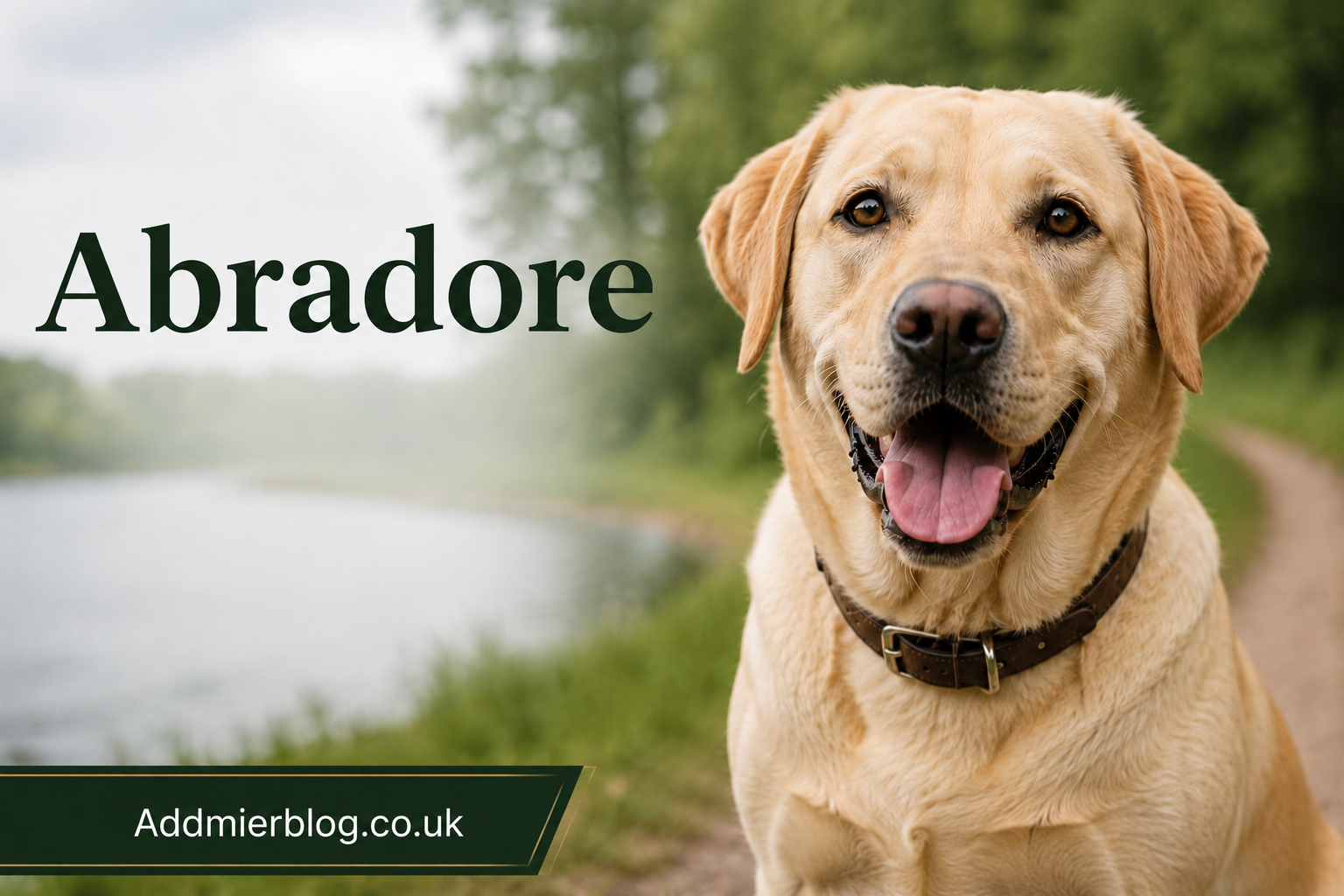
Abradore is a term that appears in online searches about dogs, but it is not the official name of a recognised breed. In most cases, people use Abradore as a spelling variation of Labrador or Labrador Retriever. Major kennel organisations list the breed as the Labrador Retriever, not Abradore. Anyone researching an Abradore is therefore usually looking for information about the Labrador’s history, behaviour, physical features, care needs, and suitability as a companion or working dog.
The Labrador Retriever is widely used as a family companion, working gundog, service dog, and guide dog. Its popularity comes from a practical mix of intelligence, energy, trainability, and social behaviour. However, it is not an effortless dog to own. Labradors need exercise, structured training, controlled feeding, grooming, veterinary care, and regular contact with people.
What Does Abradore Mean?
Abradore has no separate breed standard, registration category, or established history in recognised kennel records. The American Kennel Club and the Royal Kennel Club both use Labrador Retriever as the formal name. Abradore is therefore best treated as a non-standard spelling rather than a distinct dog breed.
The confusion may come from the pronunciation of Labrador or from people shortening the name to Lab. Some sellers may also use Abradore when describing a Labrador cross. The term alone does not explain a dog’s parentage, so buyers should ask whether the animal is a pure Labrador Retriever, a crossbreed, or simply labelled with an informal spelling.
Origin and Development
The breed developed from working water dogs associated with Newfoundland. These dogs helped fishing communities retrieve nets, lines, and objects from cold water. A smaller working variety, commonly called the St John’s dog, contributed to the modern Labrador. Dogs taken from Newfoundland to Britain attracted attention because of their swimming and retrieving ability.
British breeders developed them further as gundogs for retrieving game on land and in water. The Royal Kennel Club states that an early supporter, the Earl of Malmesbury, helped give the breed its name, while the first breed club was founded in 1916.
This working history explains why many Labradors enjoy carrying toys, following scents, swimming, and staying close to a handler. These habits are connected to generations of selective breeding rather than being simple play behaviour.
Physical Appearance
A Labrador is a medium-to-large, strongly built dog with an athletic body. The Labrador Retriever Club standard describes a broad head, powerful jaws, short dense coat, and thick “otter” tail. Adult males are generally about 22.5 to 24.5 inches at the shoulder and weigh between 65 and 80 pounds. Females are commonly about 21.5 to 23.5 inches and weigh between 55 and 70 pounds.
The coat is short, straight, and dense, with an undercoat that offers protection from water and cold.Yellow can range from pale cream to fox red, while chocolate may vary from light to dark brown.
Temperament and Behaviour
Labradors are generally described as friendly, outgoing, adaptable, and willing to cooperate. The official breed standard places strong emphasis on a stable, non-aggressive temperament and eagerness to please. These traits support the breed’s use in homes, field work, and assistance programmes.
Breed descriptions do not guarantee the behaviour of every dog. Temperament is also shaped by breeding, socialisation, training, health, and previous experience. A poorly socialised Labrador may become fearful, overexcited, destructive, or difficult to control.
Young Labradors can be physically strong before they develop good manners. Jumping, pulling on the lead, chewing, stealing food, and overexcited greetings are common management problems. They are usually improved through consistent training, but owners should not expect a naturally obedient dog without effort.
Exercise and Mental Activity
Exercise is a basic requirement. The Royal Kennel Club lists more than two hours per day as a general guide for an adult Labrador, while Dogs Trust describes the breed as high-energy and in need of daily walks, play, exploration, and mental activity. The right amount depends on age, health, fitness, and personality.
Puppies should not be pushed into long-distance running or repeated high-impact exercise while they are still growing. Older dogs and those with joint, heart, or weight problems may need a reduced or modified routine based on veterinary advice.
Useful activities include walking, retrieving, safe swimming, scent games, obedience practice, and food puzzles. Physical movement alone may not prevent boredom. A Labrador also benefits from tasks that require concentration and problem-solving.
Training an Abradore
Training should begin when the dog enters the home. Early priorities include toilet training, recall, loose-lead walking, calm greetings, handling, and settling quietly. Labradors often respond well to reward-based methods because many are motivated by food, toys, praise, and interaction.
Consistency is important. Household members should use the same commands and rules. Allowing jumping in one situation and punishing it in another creates confusion. Short, repeated lessons normally work better than long sessions.
Training should continue beyond puppyhood. Adolescent Labradors may test boundaries, become distracted outdoors, or ignore commands around people and other animals. Regular practice helps the dog understand that the same rules apply in different locations.
Feeding and Weight Management
Labradors are often keen eaters, making portion control important. Food should match the dog’s age, health, activity, and body condition. Instructions on a food package are only a starting point and may need adjustment.
At an ideal body condition, the ribs should be easy to feel under a thin layer of fat, and a waist should be visible from above. If the ribs are difficult to feel and the waist disappears, the dog may be overweight. Dogs Trust recommends using body condition when deciding how much to feed.
Extra weight increases strain on joints and can reduce comfortable movement. Table scraps, chews, and training treats may add significant calories. Regular weighing and veterinary checks help owners notice gradual changes.
Meals should be measured rather than estimated. Family members should also communicate about treats to prevent the dog from being fed several times by different people.
Grooming and General Care
The Labrador coat is simple to manage but not maintenance-free. Weekly brushing is a useful routine, with more frequent brushing during periods of heavy shedding. The Royal Kennel Club lists weekly grooming as a general guide, and Dogs Trust confirms that the short coat still sheds.
Routine care also includes nail trimming, dental care, ear checks, parasite prevention, and veterinary examinations. Dogs that swim regularly should have their ears and skin checked for redness, odour, irritation, or discharge. Wet coats should be dried properly.
The dog should become familiar with handling from an early age. Calm practice with paw touching, ear inspection, brushing, and mouth checks can make routine care easier as the animal grows.
Health and Lifespan
The Royal Kennel Club gives the Labrador a general lifespan of more than ten years, although individual lifespan depends on genetics, body condition, disease, accidents, and quality of care.
Labradors can be affected by inherited and acquired health problems. Responsible breeders use screening to reduce avoidable risk. The Orthopaedic Foundation for Animals explains that its CHIC system records breed-recommended health screening results and makes them publicly available. Buyers should request verifiable records rather than accepting a verbal claim that the parents are healthy.
Hip and elbow evaluation, eye testing, and relevant DNA screening are commonly considered in Labrador breeding. Testing cannot guarantee that a puppy will never become ill, but it shows that known risks were assessed. Prospective owners should also ask about the health and lifespan of close relatives.
Regular veterinary examinations remain important throughout the dog’s life. Changes in movement, appetite, body weight, thirst, behaviour, hearing, or vision should not be ignored.
Family Life and Other Animals
A well-bred and trained Labrador can live successfully with children, but supervision remains necessary. A large young dog can knock over a small child without intending harm. Children should not climb on the dog, disturb it while eating or sleeping, pull its ears, or remove items from its mouth.
Labradors may also live with dogs and cats when introductions are controlled. Their friendly reputation is not a reason to rush the process. Each animal should have separate access to food, rest, and personal space at first.
Families should consider the dog’s energy level before bringing one home. A Labrador may not suit a household that wants a quiet dog requiring little daily activity.
Working and Service Roles
The Labrador has served as a gundog, guide dog, service dog, detection dog, rescue dog, and therapy dog. Its retrieving instinct, trainability, physical ability, and tendency to work closely with people support these roles. The Royal Kennel Club describes the Labrador as a family companion, service dog, guide dog, and working gundog.
These working roles also show why Labradors need mental direction. A household dog may not perform professional work, but it can still benefit from retrieving named toys, following scent trails, learning new commands, or participating in organised dog activities.
Choosing an Abradore Responsibly
Anyone searching for an Abradore puppy should first confirm what breed is being offered. Because Abradore is not an official breed name, the label may hide unclear parentage or missing documentation. Buyers should see the mother with the litter, review health certificates, confirm identification details, and examine the conditions in which the puppies are raised.
A responsible breeder should be willing to answer questions about health, behaviour, feeding, socialisation, and the puppy’s parents. Pressure to pay quickly, refusal to show records, or offers to deliver a puppy without meeting the buyer should be treated carefully.
Rescue organisations are another option. Adult Labradors and Labrador crosses may need new homes because of changes in housing, finances, health, or family circumstances. An adult dog may already have some training, although it may need time and support to adjust.
The main question is not coat colour or public popularity. It is whether the household can provide exercise, training, company, food management, veterinary care, and long-term responsibility.
Common Misunderstandings About Abradore
One common misunderstanding is that Abradore is a rare or newly developed breed. There is no recognised evidence supporting that claim. In most cases, it is simply another spelling used for Labrador.
Another misunderstanding is that every Labrador is calm, easy to train, and suitable for every family. Labradors often have useful social and working qualities, but young dogs can be demanding. Without enough exercise and training, they may become difficult to manage.
Short hair is also sometimes mistaken for low shedding. Labradors have dense double coats and can leave noticeable hair around the home. Regular brushing reduces loose hair but does not stop shedding completely.
Conclusion
Abradore is best understood as an informal or incorrect spelling of Labrador Retriever rather than a separate recognised breed. The Labrador developed from Newfoundland water dogs and was later established in Britain as a retriever. Its main traits include a strong build, dense coat, social temperament, retrieving instinct, and ability to work closely with people.
A friendly nature does not remove the need for responsible ownership. Labradors require exercise, training, weight control, grooming, health care, and regular human involvement. For an active household prepared to meet those needs, the dog commonly searched for as an Abradore can become a dependable companion and capable working partner.