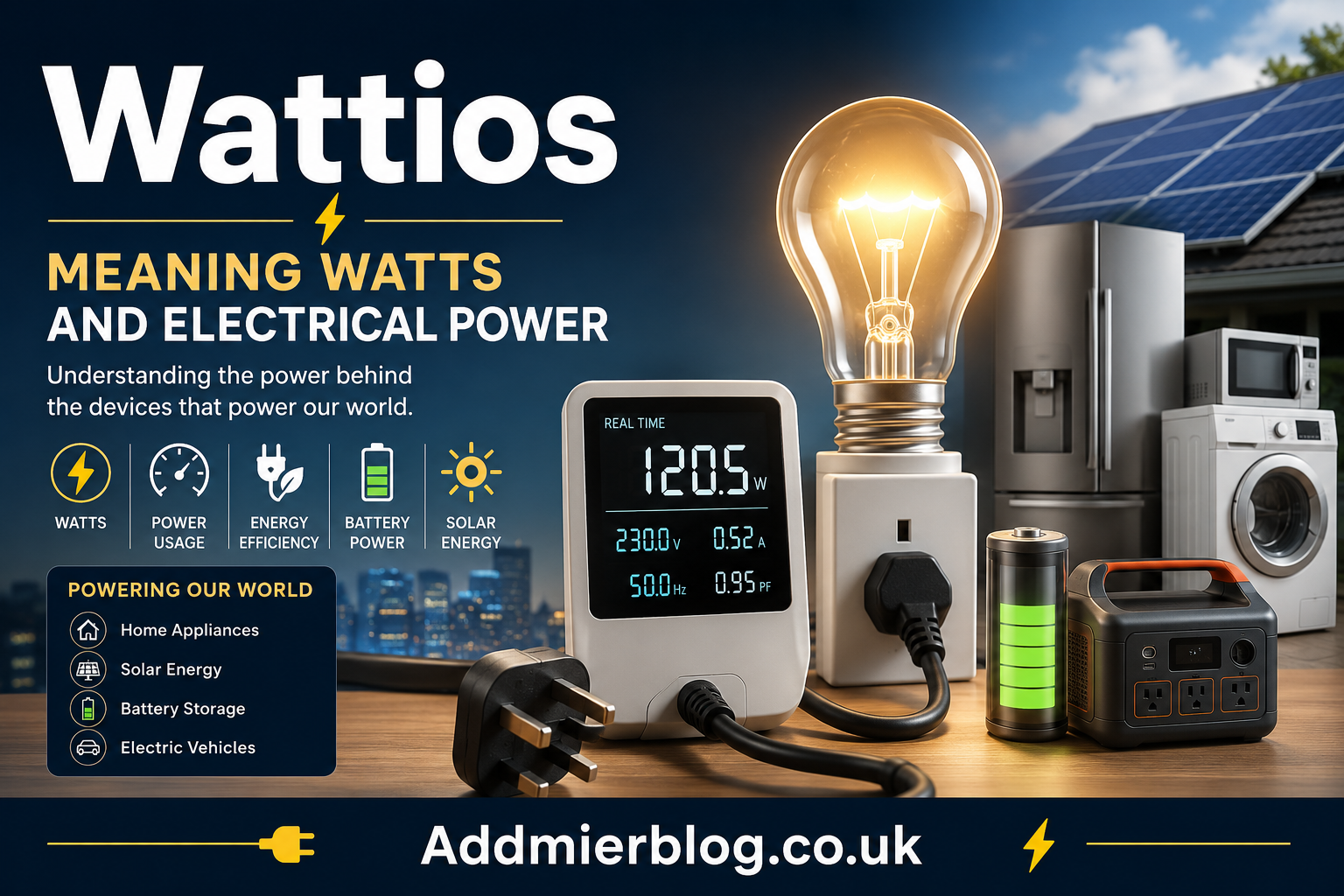
Introduction to Wattios
Wattios is a term that appears in online searches, product descriptions, informal technical discussions, and multilingual content about electricity. In most cases, it refers to watts, the standard unit used to measure power. The recognised English term is “watt,” while the accepted Spanish term is “vatio.” The official symbol is W. Wattios is therefore best treated as an informal spelling variation, not a separate electrical unit.
Understanding Wattios is useful because power ratings appear on almost every electrical product. Light bulbs, chargers, heaters, refrigerators, solar panels, generators, and motors carry watt ratings. These figures show how quickly a device uses, produces, or transfers energy.
A watt does not measure the total electricity consumed over a long period. It measures the rate of energy use at a particular moment. One watt equals one joule of energy transferred or used per second. This distinction between power and energy is central to reading appliance labels, estimating electricity costs, and comparing equipment.
What Does Wattios Mean?
The simplest explanation is that Wattios means watts in most practical contexts. The spelling may come from mixing the English word “watt” with the Spanish plural “vatios.” However, it is not the official spelling used by the International System of Units.
The formal unit name is watt, and its symbol is a capital W. A 60-watt lamp may be written as 60 W, while a 2,000-watt heater may be shown as 2,000 W or 2 kW. The number describes the appliance’s power level, not necessarily the exact amount of electricity it will consume under every condition.
Manufacturers, engineers, electricians, energy suppliers, and regulators use standard names and symbols to reduce confusion. Someone may search for Wattios, but equipment labels and technical documents normally use W, kW, MW, or GW. Symbols for scientific units remain consistent across languages, even when the written name of the unit changes.
What a Watt Measures
A watt measures power. Power is the rate at which energy is transferred, converted, produced, or consumed. In an electrical system, it describes how quickly electrical energy is being used to perform work.
For example, a 10 W LED lamp uses electrical energy at a lower rate than a 60 W incandescent lamp. A 2,000 W heater uses energy much faster because heating requires a higher power output. A 5 W phone charger transfers less power than a 65 W laptop charger, although the real charging rate also depends on the connected device.
The basic definition is:
1 watt = 1 joule per second
A device operating at 100 W therefore transfers or consumes 100 joules of energy every second. If it continues running, the total energy used increases with time.
Power can describe consumption or production. A heater consumes electrical power and converts much of it into heat. A solar panel produces electrical power from sunlight. A motor consumes electrical power and converts part of it into mechanical movement.
The same unit applies in each case because the watt measures the rate of energy transfer, regardless of the device or energy source.
Watts, Volts, and Amps
Electrical power is often calculated by multiplying voltage by current:
Power in watts = voltage × current
The formula is written as:
P = V × I
Here, P represents power in watts, V represents voltage in volts, and I represents current in amperes.
Consider a device operating at 230 volts and drawing 2 amperes:
230 V × 2 A = 460 W
This calculation works directly for many direct-current systems and simple resistive loads. It helps explain why both voltage and current matter when assessing an electrical appliance.
Voltage can be viewed as the electrical potential that drives current through a circuit. Current describes the rate at which electric charge flows. Watts show how much electrical power results from the combination of voltage and current.
Alternating-current equipment can be more complex because power factor may also need to be considered. In an alternating-current circuit, real power may be calculated by multiplying volts, amperes, and the power factor.
For ordinary household comparisons, the watt rating printed on the appliance is usually the most practical figure.
Wattios and Electrical Energy Are Different
One of the most common mistakes is treating watts and watt-hours as if they mean the same thing. Watts measure power. Watt-hours measure energy used or produced over time.
A 100 W television running for one hour uses:
100 W × 1 hour = 100 Wh
If it runs for ten hours, it uses:
100 W × 10 hours = 1,000 Wh, or 1 kWh
Electricity suppliers usually bill customers in kilowatt-hours. One kilowatt-hour is the energy used by a 1,000 W device operating for one hour. It can also represent a 100 W device running for ten hours or a 500 W appliance running for two hours.
This explains why a high-wattage appliance does not always create the largest electricity cost. A 2,000 W kettle may run for only a few minutes, while a lower-powered refrigerator operates in cycles throughout the day.
Total energy use depends on both power and operating time. Looking only at the watt rating does not provide a complete picture of electricity consumption.
Reading Watt Ratings on Appliances
A watt rating indicates the power an appliance requires under stated conditions. However, the figure may represent maximum power, normal operating power, input power, output power, or a tested value.
A microwave may advertise its cooking output while drawing more power from the wall. Some energy is lost through the appliance’s electronics, fan, lighting, and heat production.
A computer may include a 600 W power supply but consume far less during normal work. The rating shows the maximum power the supply is designed to provide, not the amount the computer constantly uses.
An air conditioner may also change its power use as the compressor cycles or an inverter adjusts its operating speed. The appliance may draw high power when cooling demand is strong and less power after the room reaches the selected temperature.
Routers, televisions, consoles, and smart devices may draw power in standby mode. Small continuous loads can add to yearly consumption, particularly when several devices remain connected at all times.
Wattios in Lighting
Lighting is one area where watt ratings are often misunderstood. With older incandescent bulbs, higher wattage usually meant more light because the bulbs had similar levels of efficiency. Modern LED lamps use much less power to produce the same amount of visible light.
Watts should not be treated as a direct measure of brightness. Brightness is measured in lumens. Two bulbs using the same number of watts may produce different amounts of light if one converts electricity into visible light more efficiently.
An old 60 W incandescent bulb can often be replaced by an LED using approximately 5.9 W to 10.5 W while producing about 800 lumens. The lower watt figure means lower power demand, not weaker performance.
Lumens are therefore more useful when comparing brightness. Other factors, including colour temperature, beam angle, fitting type, and dimmer compatibility, should also be considered when selecting a lamp.
A low-wattage LED can provide enough light for a room while using considerably less electricity than an older incandescent bulb. This difference shows why watt ratings must be interpreted in relation to efficiency and output.
Wattios in Solar Power
Solar panels are rated according to the power they can produce under standard test conditions. A panel marked 450 W can reach that output under specified testing conditions, but real production changes with sunlight, temperature, panel angle, shading, dust, wiring losses, and inverter performance.
Standard test conditions provide a common reference for comparing photovoltaic products. Actual outdoor conditions rarely remain fixed, so field output can be higher or lower at different times.
Ten 450 W panels create a nominal system size of:
450 W × 10 = 4,500 W
The system may therefore be described as a 4.5 kW solar installation.
This does not mean it produces 4.5 kW at every moment. Output rises after sunrise, changes with weather conditions, reaches its highest level during strong sunlight, and falls towards sunset.
The watt or kilowatt rating shows the system’s power capacity. Kilowatt-hours show how much energy the system actually generates during a day, month, or year.
This distinction is important when comparing solar systems. Two installations with the same kilowatt rating may generate different amounts of energy because of their location, orientation, shading, maintenance, equipment quality, and local climate.
Wattios in Batteries and Chargers
Battery labels use several electrical units. Voltage describes electrical potential, ampere-hours describe charge capacity, watt-hours describe stored energy, and watts describe power delivery or charging speed.
A battery rated at 12 V and 100 Ah has a theoretical energy capacity of:
That equals 1.2 kWh.
Actual usable energy may be lower because of discharge limits, conversion losses, temperature, battery condition, and ageing. Some battery types should not be completely discharged because deep discharge can reduce their working life.
A 20 W charger can normally deliver more power than a 5 W charger. However, faster charging only occurs when the connected phone, tablet, or other device supports the higher rate.
The charger does not force its full rated output into every device. Modern charging systems regulate power according to the battery’s condition, temperature, cable capability, charging protocol, and device design.
The watt rating on a charger usually represents its maximum output. Real power delivery may decrease as the battery approaches full charge or when the device becomes warm.
Why Higher Wattage Is Not Always Better
Higher wattage means a higher rate of power use or delivery. It does not automatically mean better quality, stronger performance, or greater efficiency.
A high-wattage heater may warm a room faster, but it also draws more power. A smaller heater may be more suitable for a compact room, while a larger model may be needed for a bigger space.
A higher-rated computer power supply does not make a computer faster. It only states the maximum power the supply can provide to the computer’s components.
The same principle applies to speakers, motors, chargers, generators, and kitchen appliances. Wattage must be considered alongside efficiency, output, operating conditions, compatibility, safety limits, and intended use.
An appliance that completes a task with fewer watts may be more efficient. However, a lower watt rating is not always better either. Equipment must have enough power to perform its intended job correctly.
Measuring Power and Estimating Cost
Power can be checked with plug-in energy meters, smart plugs, clamp meters, and building energy monitors. A plug-in meter can show real-time watt draw and record kilowatt-hours over time.
Actual use often differs from the figure on the label. A refrigerator changes its power demand as the compressor switches on and off. A laptop varies according to screen brightness, processor activity, battery charging, and connected accessories.
A washing machine draws different power levels during heating, spinning, pumping, and idle periods. Measuring it for only a few seconds may not provide an accurate picture of a full washing cycle.
Electricity cost can be estimated by converting watts into kilowatts, multiplying by operating time, and applying the local price per kilowatt-hour.
For a 1,500 W heater running for three hours:
1,500 W ÷ 1,000 = 1.5 kW
The final cost is calculated by multiplying 4.5 kWh by the electricity tariff. Actual bills may also include taxes, fixed charges, tariff bands, fuel adjustments, or time-of-use pricing.
Safety and Wattage Limits
Watt ratings also matter for safety. Extension leads, sockets, plugs, inverters, generators, power banks, and circuit breakers have operating limits.
Exceeding those limits can cause overheating, voltage drop, equipment damage, melted connections, or fire. High-wattage appliances can draw substantial current, especially heaters, kettles, ovens, hair dryers, and air conditioners.
Safe operation also depends on voltage, current rating, cable size, connection quality, ventilation, and local electrical standards. High-power equipment should not be connected through overloaded adapters or unsuitable extension leads.
The appliance instructions and the ratings printed on plugs, sockets, cables, and power supplies should always be checked before equipment is connected.
Conclusion
Wattios is best understood as an informal spelling used when people mean watts. The official unit is the watt, represented by W, and it measures the rate at which energy is used, produced, or transferred. One watt equals one joule per second.
The main distinction is between watts and watt-hours. Watts describe power at a particular moment, while watt-hours and kilowatt-hours describe energy over time. That difference explains appliance labels, solar panel ratings, battery capacity, charging speed, and electricity bills.
Understanding power, operating time, voltage, current, and energy makes it easier to compare devices, estimate costs, and select suitable equipment. It also helps consumers interpret technical labels without assuming that higher wattage always means better performance.